 WireGaugeCalc
111 Apartment Fire Statistics October 2026
On this page
- Multifamily Fire Statistics: How Many Fires, Deaths and Injuries Happen Each Year?
- Are Apartment Fires Getting Less Deadly Over Time?
- What Causes Apartment Fires?
- Do Electrical Problems Start Apartment Fires?
- When and Where Do Apartment Fires Start?
- Do Smoke Alarms and Sprinklers Change the Outcome in Apartments?
- How Dangerous Are High-Rise Apartment Fires?
- Are Newer Apartment Buildings Safer?
- What Do State and City Records Add?
- How Do Flats in England Compare?
- What Do Apartment Fires Cost?
- Methodology and Sources
- Sources
Apartment fire statistics show a problem that is common, mostly small and getting less deadly. Most of these fires start on a stove and stay in the pot. The ones that kill start somewhere else: a bedroom, a cigarette, a couch, a fire that gets out of the first room.
This page collects the primary data on multifamily fires in one place. It uses federal fire data, national research reports, state fire marshal records and a few named fires. Every figure links to the report that published it, and each number appears once. NFPA and USFA count fires in different ways, so the two sets of totals are not meant to match. Use the year and the source named beside each number.
Electricians and apprentices work inside these buildings. Panels, feeders and branch circuits are part of the fire picture, so one section covers what the data says about electrical failure. For related reading, see the pages on house fires and electrical fires.
Key Takeaways
- In 2024, US fire departments responded to an estimated 76,000 apartment or other multifamily fires, which caused 340 civilian deaths, 2,290 civilian injuries and $2.0 billion in direct property damage (NFPA, Nov 2025).
- Apartments had 5% of reported fires in 2024 but 19% of civilian fire injuries (NFPA, Nov 2025).
- Cooking caused 74% of multifamily building fires in 2017 to 2019, against 37% of fires in one- and two-family buildings (USFA, Aug 2021).
- The 2023 death rate was 5.2 per 1,000 reported apartment fires and 9.7 per 1,000 reported fires in one- or two-family homes (NFPA, Aug 2025).
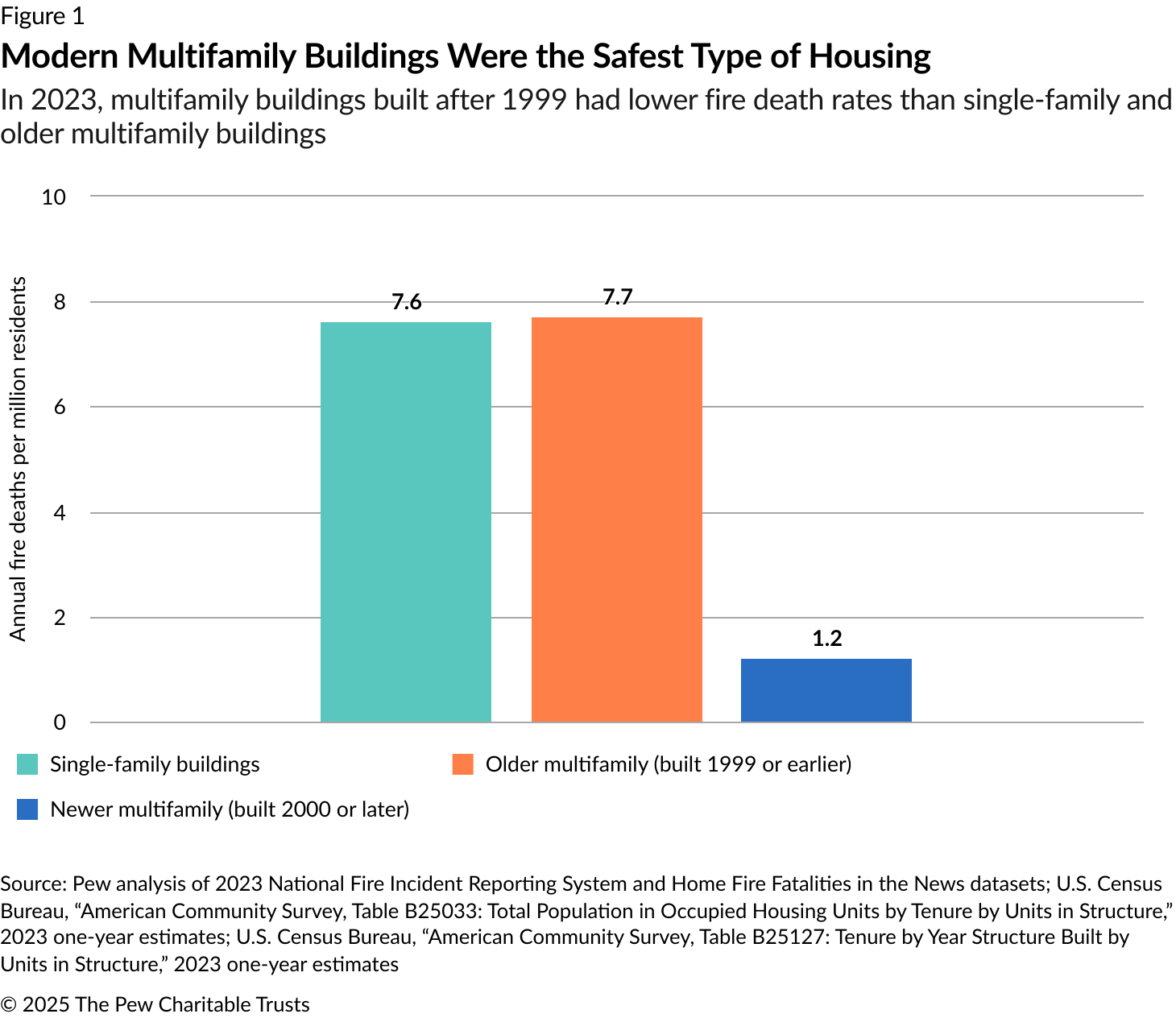
- Apartments built in 2000 or later had 1.2 fire deaths per million residents in 2023, against 7.6 in single-family homes and 7.7 in older apartments (Pew Charitable Trusts, Sep 2025).
- Fires that spread past the room where they started were about one in ten apartment fires but about two in three apartment fire deaths in 2019 to 2023 (NFPA, Aug 2025).
- Open flame and smoking materials were the heat source in 10% of apartment fires and 41% of apartment fire deaths in 2019 to 2023 (NFPA, Aug 2025).
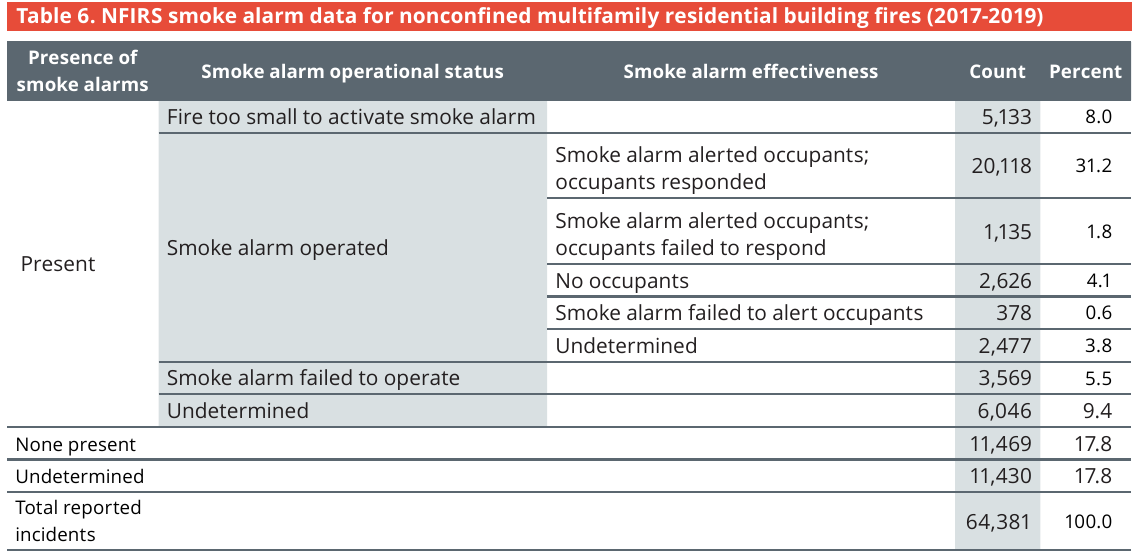
- Smoke alarms were present in 64% of nonconfined multifamily fires, and no alarm was present in at least 18% (USFA, Aug 2021).
- Home fires with sprinklers present had a civilian death rate 90% lower than home fires with no automatic extinguishing system, and the count includes apartments (NFPA, Oct 2026).
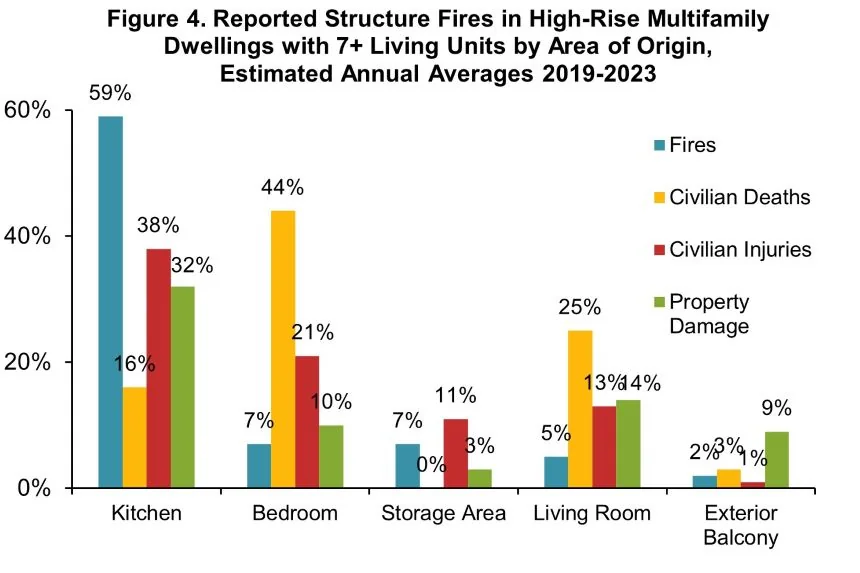
- In high-rise multifamily buildings with seven or more units, bedroom fires were 7% of fires and caused 44% of civilian deaths (NFPA, Oct 2025).
- In England, 2 of the 27 fire deaths in purpose-built flats in the year to March 2026 were in high-rise flats, and high-rise flats had the lowest death rate of any dwelling type at 2.9 per 1,000 fires (UK MHCLG, Aug 2026).
- Minnesota fire departments recorded 55 sprinkler saves in multifamily buildings in 2024 (Minnesota State Fire Marshal, Dec 2024).
- The Philadelphia Fire Department found six inoperable or disabled smoke alarms in the unit where 12 people died on January 5, 2022 (City of Philadelphia, Jan 2022).
- Builders finished 484,000 multifamily units in 2025, and 61% of them were in buildings of four floors or more (US Census Bureau, Dec 2025).
Multifamily Fire Statistics: How Many Fires, Deaths and Injuries Happen Each Year?
Apartments are a large share of fire calls and a small share of fire deaths. The gap comes from the buildings: more rules, more alarms and more people nearby to notice a fire.
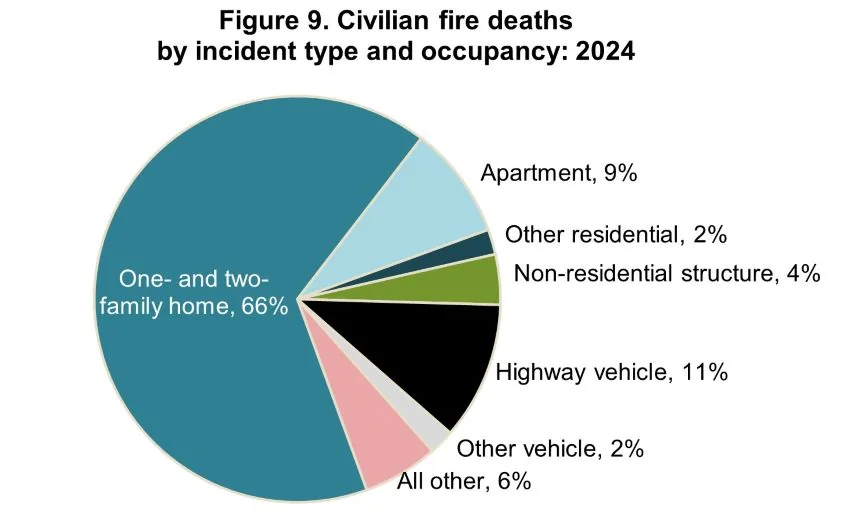
How many apartment fires happen in a typical year?
Fire departments reported an estimated average of 106,700 multifamily building fires a year from 2017 to 2019 (USFA, Aug 2021).
- NFPA’s five-year average for 2019 to 2023 is 103,964 apartment or multifamily fires, 389 civilian deaths, 3,541 civilian injuries and $1.864 billion in direct property damage a year (NFPA, Aug 2025).
- Multifamily buildings accounted for 29% of all residential building fires, and 71% of multifamily fires were small, confined fires (USFA, Aug 2021).
How big is the apartment share of residential fire losses?
Multifamily buildings had 14% of residential fire deaths, 33% of injuries and 21% of dollar loss from 2017 to 2019 (USFA, May 2021).
- Multifamily dwellings were 14.5% of residential fatal fires from 2018 to 2020 (USFA, Jun 2022).
- They were 11.4% of residential fires that killed more than one person from 2021 to 2023, and 15.1% of fires that killed one person (USFA, Dec 2024).
How lethal is a multifamily fire compared with other homes?
The average multifamily fire killed 3.1 people per 1,000 fires, against 7.5 for other residential buildings (USFA, Aug 2021).
- The injury rate runs the other way: 29.3 injuries per 1,000 multifamily fires, against 23.9 for other residential buildings (USFA, Aug 2021).
- NFPA says apartments are more likely to have sprinklers than one- or two-family homes, and more regulated, which helps explain the lower death rate (NFPA, Aug 2025).
Are Apartment Fires Getting Less Deadly Over Time?
Deaths have fallen a long way since 1980. Injuries have not, and the decline in deaths has flattened.
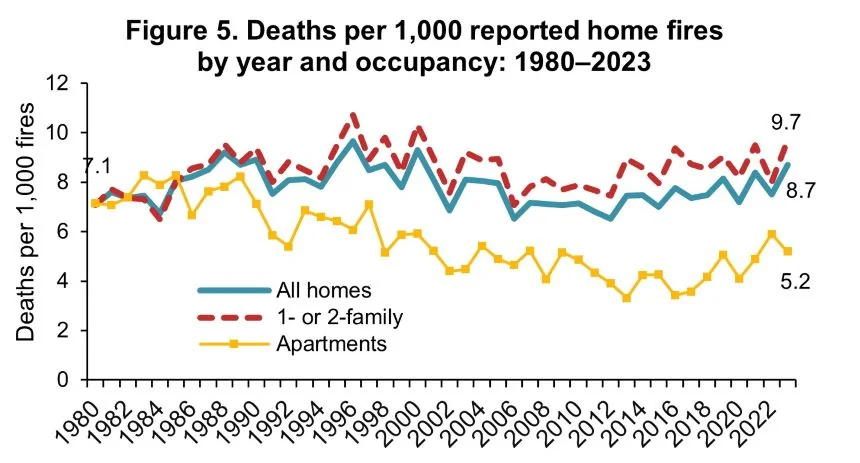
How much have apartment fires and deaths fallen since 1980?
Apartment fires were 47% lower in 2024 than in 1980, apartment fire deaths were 67% lower and apartment fire injuries were 36% lower (NFPA, Nov 2025).
- From 2023 to 2024, apartment fire deaths fell 15%, injuries fell 16% and property damage fell 16% (NFPA, Nov 2025).
What is the death rate per 1,000 apartment fires now?
The 2024 rate was 4.5 deaths per 1,000 reported apartment fires, 37% below the 1980 rate of 7.1 (NFPA, Nov 2025).
- The 2024 injury rate was 30.1 per 1,000 apartment fires, 20% above the 1980 rate of 25 (NFPA, Nov 2025).
- NFPA cautions that reporting shapes these rates. Monitored alarms send the fire department to minor fires, and 61% of reported apartment fires from 2019 to 2023 were cooking fires, many already out on arrival (NFPA, Aug 2025).
What Causes Apartment Fires?
Cooking starts most apartment fires, but cooking is not what kills most people. The deaths come from smoking materials, open flames and fires that grow past the first room.
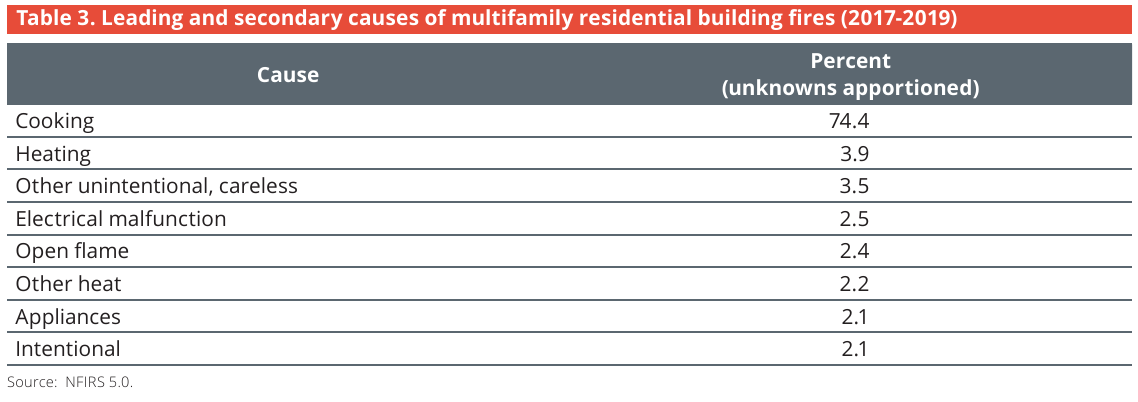
Is cooking the leading cause of apartment fires?
Yes. Of the cooking fires in multifamily buildings, 95% were small, confined fires with limited damage (USFA, Aug 2021).
- Multifamily buildings had 46% of residential cooking fires (USFA, Jul 2021).
- Apartments had 31% of home fires but 47% of home cooking fires from 2017 to 2021 (NFPA, Sep 2023).
- Kitchen and cooking equipment was involved in 63,642 apartment fires a year (61%) but 94 deaths (24%) from 2019 to 2023 (NFPA, Aug 2025).
Which causes kill the most people in apartment fires?
Cigarettes started 3,122 apartment fires a year (3%) and caused 67 deaths (17%) from 2019 to 2023 (NFPA, Aug 2025).
- Upholstered furniture was the first item ignited in 930 fires a year (1%) and 71 deaths (18%) (NFPA, Aug 2025).
- A heat source too close to combustibles contributed to 8,368 fires a year (8%) and 70 deaths (18%) (NFPA, Aug 2025).
How much do heating and misuse add to apartment fires?
Heating caused 4% of multifamily fires, against 12% of fires in one- and two-family buildings (USFA, Aug 2021).
- Multifamily buildings accounted for 13% of residential heating fires (USFA, Dec 2021).
- They accounted for 8% of residential portable heater fires (USFA, Dec 2021).
- Misuse of a material or product contributed to 45% of larger multifamily fires, with abandoned or discarded materials at 16% and a heat source too close to combustibles at 15% (USFA, Aug 2021).
- Operational deficiency contributed to 21% of larger multifamily fires, and unattended equipment alone to 12% (USFA, Aug 2021).
Do Electrical Problems Start Apartment Fires?
Electrical failure is a small cause of apartment fires by count and a large one by harm. It is also the part of the problem that wiring and load work can address.
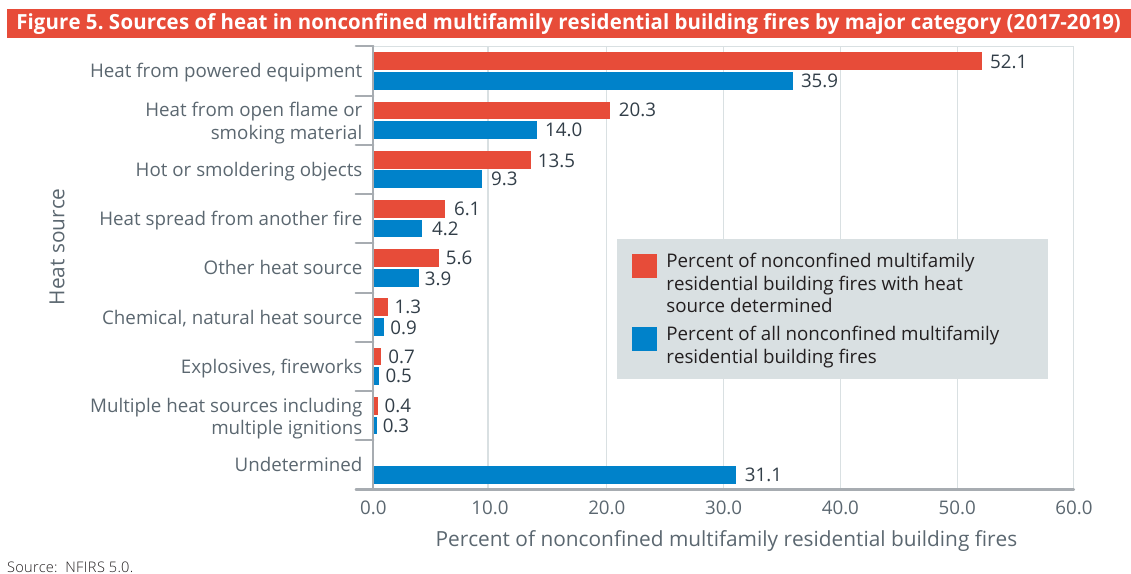
How often does electrical malfunction cause apartment fires?
Electrical malfunction caused 2.5% of all multifamily building fires and 10% of the larger, nonconfined fires (USFA, Aug 2021).
- Among fires that spread beyond the room of origin, electrical malfunction was the cause of 11% (USFA, Aug 2021).
- Electrical failure or malfunction was the third largest group of factors contributing to ignition, at 16% of larger fires (USFA, Aug 2021).
- Electrical arcing was the heat source in 11% of larger multifamily fires (USFA, Aug 2021).
- USFA explains that multifamily buildings usually have fewer electrical fires because of construction materials, building codes and professional maintenance (USFA, Aug 2021).
How deadly is electrical equipment in an apartment fire?
Electrical distribution, lighting and power transfer equipment was involved in 3,544 apartment fires a year (3%), 52 deaths (13%) and $240 million in damage (13%) from 2019 to 2023 (NFPA, Aug 2025).
- Arcing was the heat source in 4,877 fires a year (5%), 27 deaths (7%) and $210 million in damage (11%) (NFPA, Aug 2025).
- Electrical failure or malfunction contributed to 5,336 fires a year (5%) and 40 deaths (10%) (NFPA, Aug 2025).
- Overloaded equipment contributed to 302 fires and 8 deaths a year (NFPA, Aug 2025).
- Wire or cable insulation was the first item ignited in 2,887 fires a year (3%), 15 deaths (4%) and $93 million in damage (5%) (NFPA, Aug 2025).
Load, breaker and conductor sizing are the parts of this list a calculation can check. The small apartment load calculation and breaker size calculator pages cover those steps. Check the adopted code year and the local authority for the rules that apply to a job.
When and Where Do Apartment Fires Start?
Apartment fires follow dinner, not bedtime. The ones that kill follow bedtime.
What time of day do apartment fires peak?
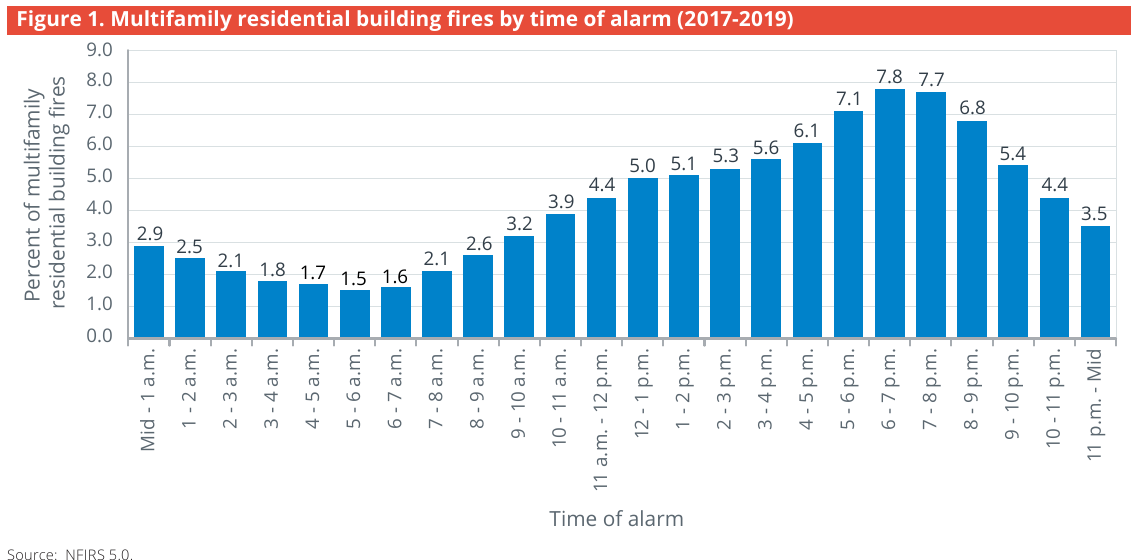
The 6 to 8 p.m. dinner window accounted for 16% of multifamily fires, and the low point was 5 to 6 a.m. (USFA, Aug 2021).
- The deadliest hour was 2:00 to 2:59 a.m., with 31 deaths a year (8%), against 15 deaths a year (4%) in the 6 p.m. hour (NFPA, Aug 2025).
Which months and days are worst?
January was the peak month, at 10% of multifamily fires, and August was the low, at 7% (USFA, Aug 2021).
- January and March each averaged 47 apartment fire deaths a year (12% each), against 20 in August (5%) (NFPA, Aug 2025).
Where in the apartment do fires start?
Apartment fires were more likely to start in the kitchen (68%) than fires in one- or two-family homes (30%) (NFPA, Aug 2025).
- Bedrooms started 4,127 apartment fires a year (4%) and 99 deaths (26%) (NFPA, Aug 2025).
- Among larger fires, 33% began in the kitchen, 13% in bedrooms, 6% on balconies and 5% in laundry areas (USFA, Aug 2021).
- Balconies and porches started 2,682 fires a year (3%) but caused $219 million in damage (12%) (NFPA, Aug 2025).
How far do apartment fires spread?
Three-quarters of multifamily fires (75%) stayed in the object where they started, and 9% went beyond the room, against 33% in one- and two-family buildings (USFA, Aug 2021).
- Among larger fires, 31% extended beyond the room, against 54% in other residential buildings (USFA, Aug 2021).
Do Smoke Alarms and Sprinklers Change the Outcome in Apartments?
Alarms are common in apartment fires and mostly work. Sprinklers are rarer and have the larger effect.
How often are smoke alarms present and working?
Alarms were present and operated in 42% of larger multifamily fires, failed to operate in 6%, and were not triggered because the fire was too small in 8% (USFA, Aug 2021).
- In confined multifamily fires, the alarm alerted occupants in 53% (USFA, Aug 2021).
- Smoke alarms operated in 70% of reported apartment fires, against 46% of fires in one- or two-family homes (NFPA, Jun 2024).
- Multifamily homes were 7% of residential fatal fires with no smoke alarm present, while one- and two-family homes were 87% (USFA, Jun 2022).
- Multifamily homes were 5% of multiple-fatality fires with no smoke alarm present (USFA, Dec 2024).
- Minnesota’s 2024 smoke alarm performance table lists 434 multifamily fires, with the alarm operating in 330 and failing in 23 (Minnesota State Fire Marshal, Dec 2024).
How much do sprinklers help in apartment buildings?
Automatic extinguishing systems, which include sprinklers, were present in 15% of larger multifamily fires, against 2% of larger fires in other residential buildings (USFA, Aug 2021).
- Sprinklers were present in 8% of home fires from 2020 to 2024, and the count includes apartments (NFPA, Oct 2026).
- Sprinklers operated in 93% of home fires large enough to activate them, and they were effective in 98% of the fires where they operated (NFPA, Oct 2026).
- Average property loss per home fire was 58% lower with sprinklers present (NFPA, Oct 2026).
Does a closed door help a resident?
There can be a 900-degree difference in room temperature between a room with an open door and one with a closed door, and the open-door room can reach 1,000 degrees Fahrenheit or more (UL Research Institutes, Oct 2020).
How Dangerous Are High-Rise Apartment Fires?
High-rise apartment buildings are a small part of the fire problem, and codes require more protection in them. When that protection fails, the toll can be very large.
How many high-rise fires happen each year?
US fire departments responded to an estimated 14,830 high-rise structure fires a year from 2019 to 2023, with 33 civilian deaths, 439 injuries and $203 million in damage, about 3% of all structure fires (NFPA, Oct 2025).
- Residential properties were 85% of high-rise fires: 12,676 fires, 31 deaths and 408 injuries a year (NFPA, Oct 2025).
- Multifamily dwellings with seven or more units had 1,588 high-rise fires, 14 deaths, 152 injuries and $59 million in damage a year (NFPA, Oct 2025).
- English fire services attended 695 fires in purpose-built high-rise flats in the year to March 2026 (UK MHCLG, Jul 2026).
Where do high-rise apartment fires start?
Kitchens started 937 high-rise multifamily fires a year, which is 59% of the total, and caused 16% of the deaths and 38% of the injuries (NFPA, Oct 2025).
How does building size change the risk?
Apartment buildings with seven or more units had 17,660 fires, 154 deaths, 1,362 injuries and $1,046.2 million in damage a year from 2019 to 2023 (NFPA, Oct 2025).
- Buildings with three to six units had 11,113 fires, 126 deaths, 816 injuries and $490.8 million in damage a year (NFPA, Oct 2025).
- The Grenfell Tower fire accounted for 72 of the 73 fire deaths in English high-rise flats in the year to March 2018 (UK MHCLG, Aug 2026).
- Very tall buildings, typically over 420 feet, are required to have an additional stairway (USFA, Jan 2022).
- English fire services carried out 965 fire safety audits at purpose-built flats of 10 storeys or more in the year to March 2026, and 53% had a satisfactory result (UK MHCLG, Sep 2026).
- At 6 to 9 storeys, 51% of the 1,303 audits were unsatisfactory, the highest share of any premises type (UK MHCLG, Sep 2026).
Are Newer Apartment Buildings Safer?
Yes, by a wide margin. Pew’s data point to building age and the rules behind it, not to apartment living itself.
How much lower is the death rate in modern apartments?
Six percent of Americans lived in modern multifamily housing in 2023, but only 1% of residential fire deaths happened there (Pew Charitable Trusts, Sep 2025).
- The death rate in modern multifamily buildings was about one-fourth the rate in modern single-family homes, which was 4.9 per million residents (Pew Charitable Trusts, Sep 2025).
- Pew counted 1,969 fatal residential fire incidents in 2023: 1,641 in single-family homes and 328 in multifamily buildings (Pew Charitable Trusts, Sep 2025).
- Of the 19 states with 50 or more fire deaths in 2023, 18 had a lower death rate in modern multifamily buildings than in single-family homes (Pew Charitable Trusts, Sep 2025).
What do single-stair apartment buildings show?
New York City’s 4,440 modern single-stair buildings had the same fire death rate as other residential buildings since 2012 (Pew Charitable Trusts, Feb 2025).
- Pew found four fire deaths in modern single-stairway buildings in New York City and Seattle from 2012 to 2024, and the missing second stair played no role in any of them (Pew Charitable Trusts, Feb 2025).
- A second stairway and the connecting corridor add 6% to 13% to construction cost on a small lot (Pew Charitable Trusts, Feb 2025).
- Pew reports that the Netherlands has a residential fire death rate one-third that of the US (Pew Charitable Trusts, Feb 2025).
How much new apartment housing is being built?
Builders completed 17,000 multifamily buildings in 2025, and 84% of those built for rent had wood framing (US Census Bureau, Dec 2025).
- Fifty-three percent of the new multifamily buildings have a heat pump for heating (US Census Bureau, Dec 2025).
- Buildings with two to 19 units are 40% of the US rental stock, but only 21% of housing units built since 2000 are in them (Pew Charitable Trusts, Feb 2025).
- Renter-occupied units numbered 46.8 million in the second quarter of 2026, or 31.3% of the housing inventory (US Census Bureau, Jul 2026).
- The national rental vacancy rate was 7.3% in the second quarter of 2026 (US Census Bureau, Jul 2026).
What Do State and City Records Add?
National totals hide the cases that explain them. A state report shows the apartment share in one place, and a city report shows what went wrong in one building.
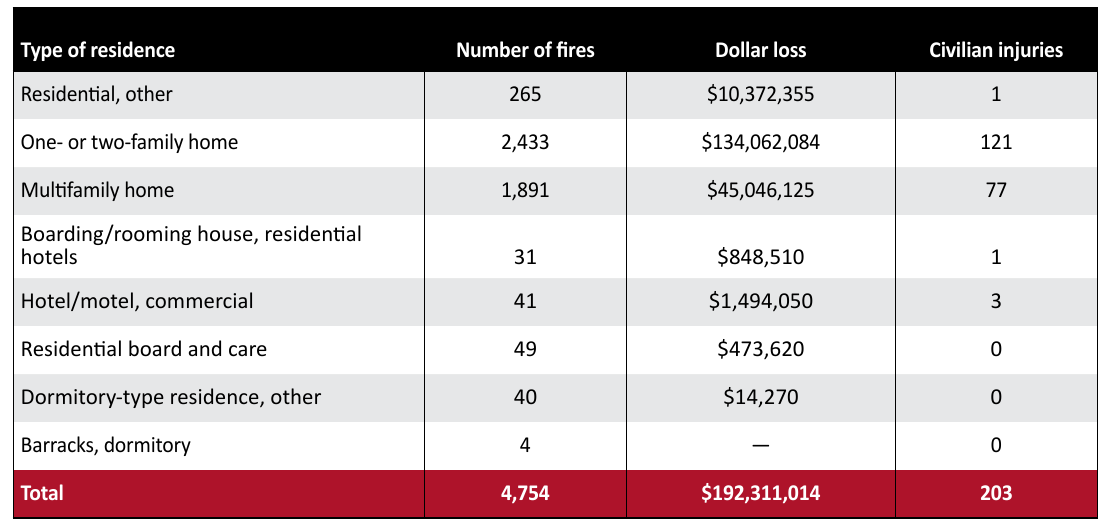
What do Minnesota records show for multifamily homes?
Minnesota fire departments reported 1,891 multifamily home fires in 2024, with $45.0 million in loss and 77 civilian injuries (Minnesota State Fire Marshal, Dec 2024).
- One- and two-family homes had 2,433 fires, $134.1 million in loss and 121 civilian injuries (Minnesota State Fire Marshal, Dec 2024).
What did the Philadelphia rowhouse fire show?
Fourteen people were in the unit when the fire began around 6:30 a.m. on January 5, 2022, and only two survived (City of Philadelphia, Jan 2022).
- The victims were nine children and three adults, and all died of smoke inhalation (City of Philadelphia, Jan 2022).
- The housing authority last inspected the two units in April and May 2021, and its representatives said all smoke detectors were working at those visits (City of Philadelphia, Jan 2022).
How Do Flats in England Compare?
England’s flats show a similar pattern. Purpose-built blocks have lower death rates per fire than houses, and one fire can dominate a ten-year average.
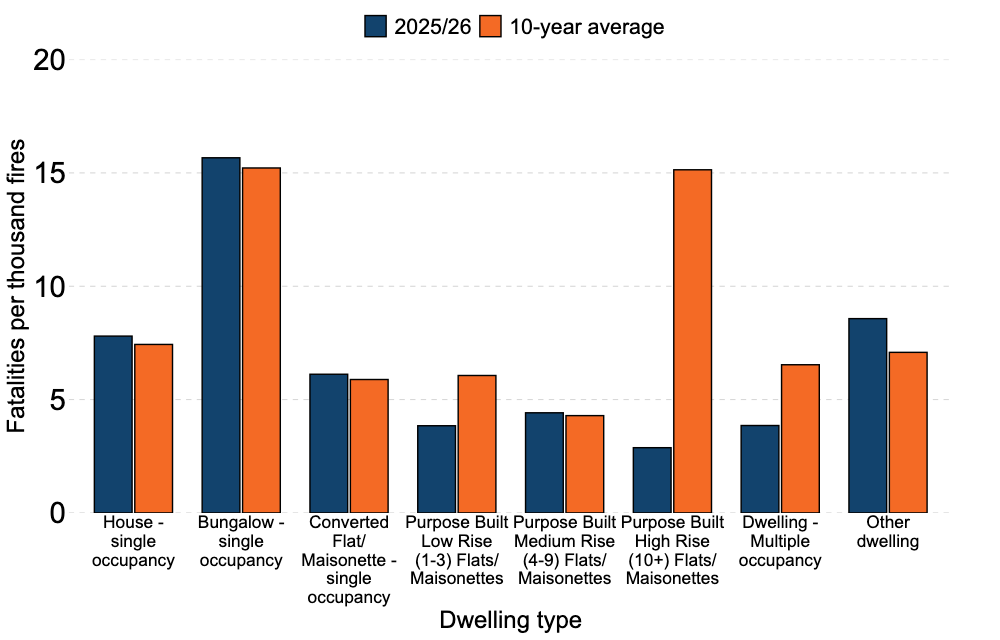
How many people die in dwelling fires in England?
England recorded 254 fire-related fatalities in the year to March 2026, a 9.3% fall on the year before (UK MHCLG, Aug 2026).
- Dwelling fires caused 184 of those deaths, which is 72% of the total (UK MHCLG, Aug 2026).
- Houses accounted for 57% of dwelling fire deaths (UK MHCLG, Aug 2026).
Which dwelling types have the highest death rates?
Houses had 7.8 deaths per thousand fires and bungalows had 15.7, the highest of any dwelling type (UK MHCLG, Aug 2026).
- Fire services rescued 2,084 people from dwelling fires (UK MHCLG, Aug 2026).
What Do Apartment Fires Cost?
A typical apartment fire costs less than the average for other residential fires. The cost is in the few fires that get out of the room.
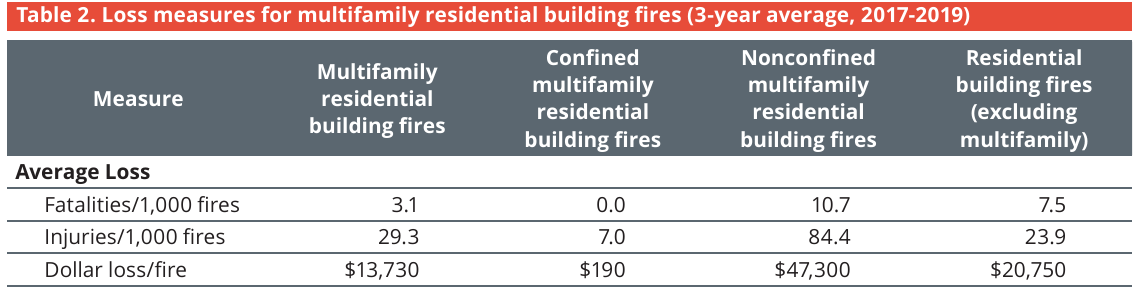
What is the average loss per apartment fire?
The average multifamily fire caused $13,730 in loss, against $20,750 for other residential building fires (USFA, Aug 2021).
- Confined multifamily fires averaged $190 a fire, and nonconfined ones averaged $47,300 (USFA, Aug 2021).
- Nonconfined multifamily fires injured 84.4 people per 1,000 fires, against 7.0 for confined fires (USFA, Aug 2021).
Which fires drive the losses?
Fires that reached beyond the floor but stayed in the building were 5% of apartment fires and caused $1,039 million in damage (56%) a year from 2019 to 2023 (NFPA, Aug 2025).
- Structural components and finishes were the first item ignited in 7,293 fires a year (7%) but $633 million in damage (34%) (NFPA, Aug 2025).
- Exterior wall coverings and finishes were the first item ignited in 1,299 fires a year (1%) and $136 million in damage (7%) (NFPA, Aug 2025).
Methodology and Sources
Each figure comes from the agency or research body that produced it. Most numbers come from the US Fire Administration, the National Fire Protection Association, state fire marshals and national statistics offices. The Pew Charitable Trusts figures come from Pew’s own analysis of federal fire data. NFPA and USFA estimate fire totals with different methods and different years, so their counts differ, and NFPA’s five-year tables differ from its single-year totals. A few figures are derived: “about one in ten” and “about two in three” in the Key Takeaways sum the NFPA table rows for fires that spread past the room of origin. State and annual-report citations carry the report year. The page is rebuilt each month when new reports appear.
Sources
- NFPA, Fire loss in the United States (Nov 2025)
- NFPA, Home Structure Fires (Aug 2025)
- NFPA, Home Structure Fires: Supporting Tables (Aug 2025)
- NFPA, High-Rise Building Fires (Oct 2025)
- NFPA, High-Rise Building Fires: Supporting Tables (Oct 2025)
- NFPA, Smoke Alarms in US Home Fires (Jun 2024)
- NFPA, Home Cooking Fires (Sep 2023)
- NFPA, US Experience with Sprinklers (Oct 2026)
- USFA, Multifamily Residential Building Fires (2017-2019), Aug 2021
- USFA, Residential Building Fires (2017-2019), May 2021
- USFA, Cooking Fires in Residential Buildings, Jul 2021
- USFA, Heating Fires in Residential Buildings, Dec 2021
- USFA, Fatal Fires in Residential Buildings (2018-2020), Jun 2022
- USFA, Multiple-Fatality Fires in Residential Buildings (2021-2023), Dec 2024
- USFA, Protecting People Who Live or Work in High-Rises, Jan 2022
- Pew Charitable Trusts, Modern Multifamily Buildings Provide the Most Fire Protection, Sep 2025
- Pew Charitable Trusts, Small Single-Stairway Apartment Buildings Have Strong Safety Record, Feb 2025
- Minnesota State Fire Marshal, Fire in Minnesota 2024
- UK MHCLG, Detailed analysis of fires, England, year ending March 2026 (Aug 2026)
- UK MHCLG, Fire and rescue incident statistics, year ending March 2026 (Jul 2026)
- UK MHCLG, Fire prevention and protection, England, year ending March 2026 (Sep 2026)
- City of Philadelphia, Preliminary findings on the Fairmount fire (Jan 2022)
- UL Research Institutes, Fire Safety Research Institute demonstration video release (Oct 2020)
- US Census Bureau, Highlights of 2025 Characteristics of New Housing
- US Census Bureau, Quarterly Residential Vacancies and Homeownership, Q2 2026 (Jul 2026)
Cite this page
Every figure links to the source that published it. Quote one with a link to this page or to the source.
WireGaugeCalc. "111 Apartment Fire Statistics October 2026." WireGaugeCalc, October 2026. https://www.wiregaugecalc.com/statistics/apartment-fire-statistics/ <a href="https://www.wiregaugecalc.com/statistics/apartment-fire-statistics/">Apartment Fire Statistics</a> (WireGaugeCalc, October 2026)