 WireGaugeCalc
154 Dryer Fire Statistics October 2026
On this page
- How many clothes dryer fires happen each year?
- How many people die or get hurt in clothes dryer fires?
- What causes clothes dryer fires?
- What catches fire first in a dryer? Dryer lint fire statistics
- Are gas or electric dryers more likely to catch fire?
- Where and when do clothes dryer fires start?
- How far do dryer fires spread, and do smoke alarms help?
- How do washing machine fires compare with dryer fires?
- Dryer vent fire statistics: what do the vent and circuit rules say?
- Which clothes dryers has CPSC recalled for fire risk?
- Methodology and Sources
- Glossary
- Sources
Dryer fire statistics tell a simple story. Most of these fires start with lint or a machine that was not cleaned. Many stay inside the dryer, and the ones that do not cost far more.
This page collects the numbers from the agencies that count them: the National Fire Protection Association (NFPA), the U.S. Fire Administration (USFA), the Consumer Product Safety Commission (CPSC) and the Energy Information Administration (EIA). Each figure names its source and date. Where two agencies measure the same thing in different years, both are shown so you can see the trend.
If you install, wire or inspect dryers, the code sections near the end matter most. They are quoted from the 2024 International Residential Code, which reprints the electrical rules. Check the code year your area has adopted, and ask the local authority.
Key Takeaways
- Fire departments responded to about 13,820 home fires a year in which a dryer was involved in ignition, with $233 million in direct property damage (NFPA, Jun 2020).
- CPSC estimates dryers were involved in 5,100 residential fires a year from 2020 to 2022, with $80.2 million in property loss (CPSC, Apr 2026).
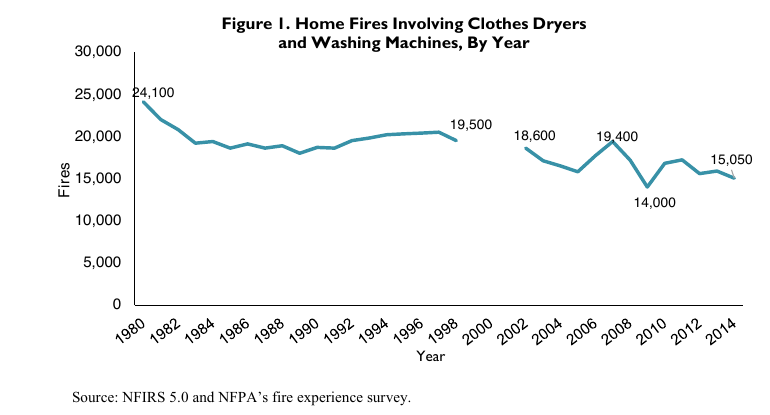
- Home fires involving dryers and washers fell from 24,100 in 1980 to 15,050 in 2014 (NFPA, Mar 2017).
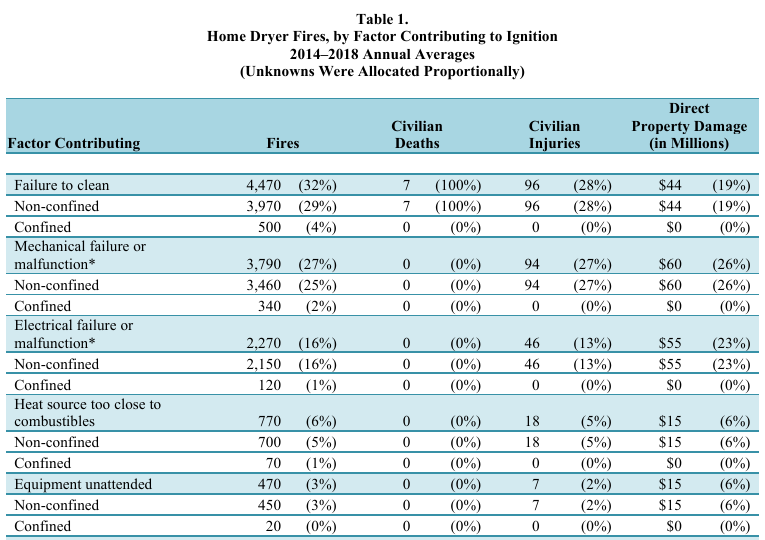
- Failure to clean was the leading factor in about one third of dryer fires and was present in all seven yearly deaths (NFPA, Jun 2020).
- Failure to clean was the leading factor in dryer fires in homes from 2018 to 2020, at 31 percent (USFA, May 2023).
- Dust, fiber and lint (28 percent) and clothing (27 percent) were by far the leading items first ignited (USFA, Aug 2012).
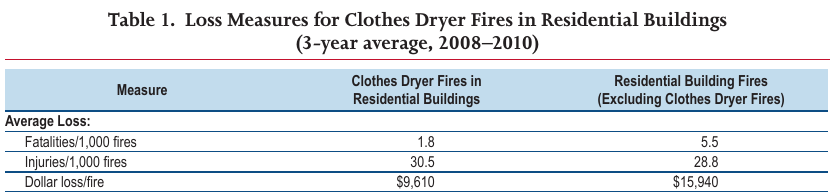
- Dryer fires killed 1.8 people per 1,000 fires, against 5.5 per 1,000 for other residential building fires (USFA, Aug 2012).
- About 78 percent of the dryers in home fires ran on electricity and 22 percent on gas (NFPA, Jun 2020).
- An estimated 102.32 million U.S. homes had a clothes dryer in 2020 (EIA, Mar 2023).
- About 4.89 million U.S. homes had a clothes dryer that was 20 or more years old (EIA, Mar 2023).
- Smoke alarms were reported absent in 15.7 percent of dryer fires in residential buildings (USFA, Aug 2012).
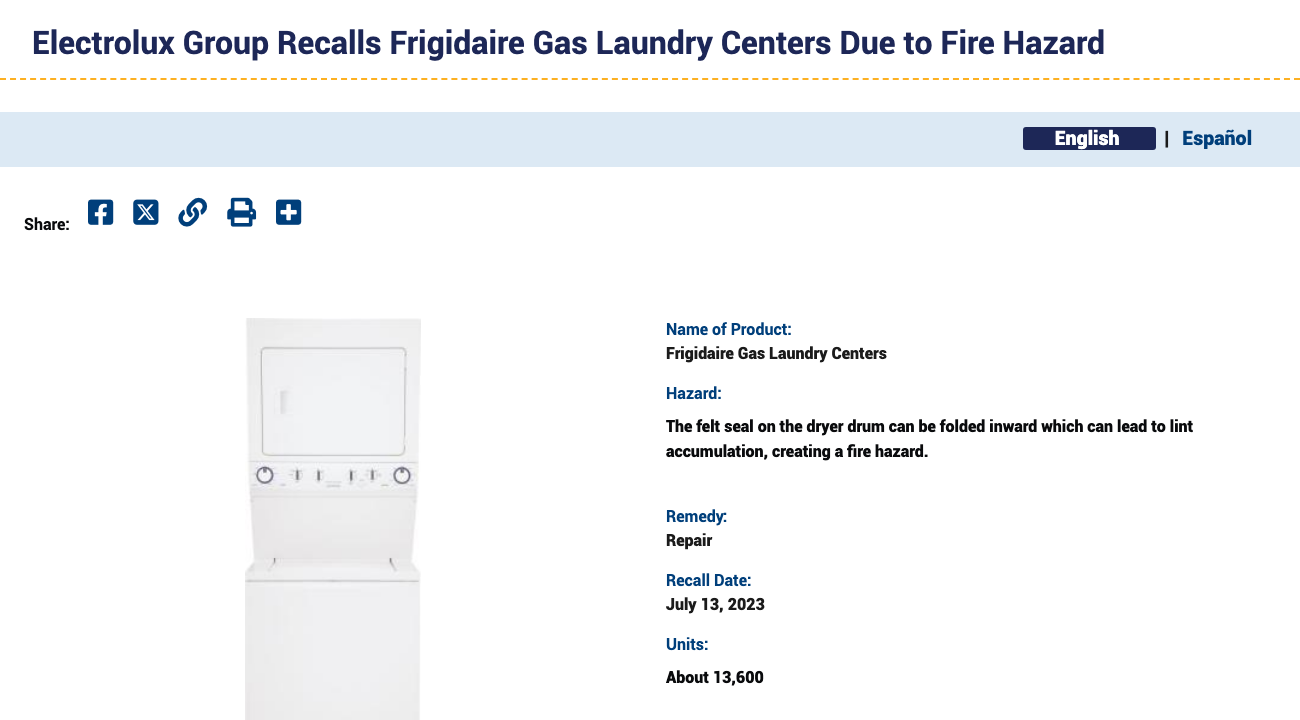
- A 2023 recall covered about 13,600 Frigidaire gas laundry centers after 23 reports of fire (CPSC, Jul 2023).
- The model residential code caps a dryer exhaust duct at 35 feet, before fittings are counted (ICC, Jan 2024).
How many clothes dryer fires happen each year?
The totals depend on who counts and how. NFPA gives the longest record, and it shows a decline. CPSC’s recent estimates also trend down.
What do NFPA estimates show?
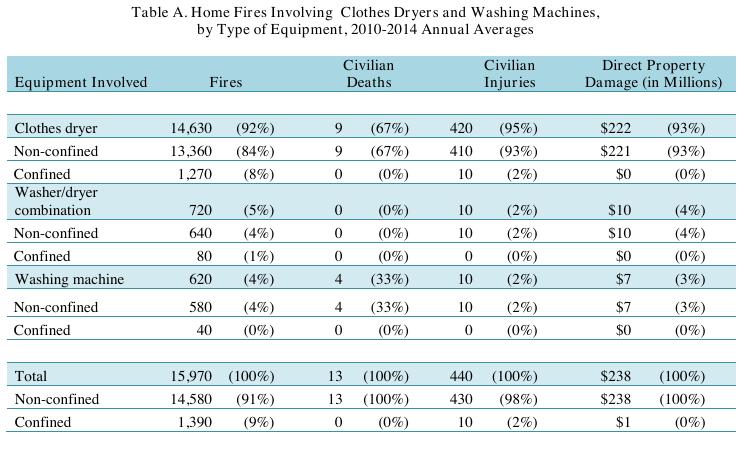
- Fire departments responded to an estimated 15,970 home fires a year involving dryers or washers in 2010 to 2014 (NFPA, Mar 2017).
- Dryers and washers accounted for 4 percent of home fires and 4 percent of direct property damage in that period (NFPA, Mar 2017).
- The low point was 14,000 fires in 2009 (NFPA, Mar 2017).
- The high point after 2000 was 19,400 fires in 2007 (NFPA, Mar 2017).
- NFPA estimated 3 percent of home civilian injuries came from fires involving dryers or washers (NFPA, Mar 2017).
What do CPSC estimates show?
- CPSC estimated 6,500 dryer fires in 2018 (CPSC, Aug 2023).
- The 2018 to 2020 average was 5,800 dryer fires a year (CPSC, Aug 2023).
- The 2019 to 2021 average was 5,300 dryer fires a year (CPSC, Jul 2024).
- The estimate for 2022 alone was 5,000 dryer fires (CPSC, Apr 2026).
What do USFA numbers add?
- USFA estimated 2,900 clothes dryer fires a year in residential buildings from 2008 to 2010 (USFA, Aug 2012).
- Eighty-four percent of clothes dryer fires in buildings occurred in residential buildings (USFA, Aug 2012).
How many people die or get hurt in clothes dryer fires?
Deaths are rare and the yearly counts jump around. Injuries and dollar losses show the cost better.
How many deaths and injuries?
- NFPA counted an average of seven civilian deaths and 344 civilian injuries a year from home dryer fires in 2014 to 2018 (NFPA, Jun 2020).
- NFPA counted 9 deaths and 420 injuries a year from fires involving clothes dryers in 2010 to 2014 (NFPA, Mar 2017).
- USFA estimated 5 deaths and 100 injuries a year in residential building dryer fires from 2008 to 2010 (USFA, Aug 2012).
- CPSC estimated 10 dryer fire deaths in 2020 and fewer than 10 in each of 2021 and 2022 (CPSC, Apr 2026).
- CPSC estimated 90 dryer fire injuries a year on average from 2020 to 2022 (CPSC, Apr 2026).
- CPSC estimated 120 dryer fire injuries a year on average from 2019 to 2021 (CPSC, Jul 2024).
- CPSC estimated 140 dryer fire injuries a year on average from 2018 to 2020 (CPSC, Aug 2023).
- Injuries per 1,000 fires were 30.5 for dryers and 28.8 for other residential building fires (USFA, Aug 2012).
- Failure to clean was tied to half of the dryer fire deaths and 34 percent of dryer fire injuries in 2010 to 2014 (NFPA, Mar 2017).
- Equipment not being operated properly was a factor in 2 percent of dryer fires but 49 percent of dryer deaths, a small-number result NFPA says to read with care (NFPA, Mar 2017).
How much damage do they cause?
- Clothes dryers accounted for $222 million of direct property damage a year in 2010 to 2014, or 93 percent of the washer and dryer total (NFPA, Mar 2017).
- CPSC estimated $91.4 million a year in dryer fire property loss from 2018 to 2020 (CPSC, Aug 2023).
- CPSC estimated $79.9 million a year from 2019 to 2021 (CPSC, Jul 2024).
- CPSC put dryer fire losses at $73.0 million in 2021 and $86.7 million in 2022 (CPSC, Apr 2026).
- The average loss per dryer fire was $9,610, against $15,940 for other residential building fires (USFA, Aug 2012).
What causes clothes dryer fires?
The cause is rarely a mystery. Lint and neglect lead, and the machine itself comes next. Only a small share comes from how people load or run it.
How big is the failure to clean problem?
- Failure to clean accounted for 4,470 dryer fires a year in 2014 to 2018 (NFPA, Jun 2020).
- Those fires caused $44 million in direct property damage a year, 19 percent of the total (NFPA, Jun 2020).
- Failure to clean accounted for 96 injuries a year, 28 percent of the total (NFPA, Jun 2020).
- In 2010 to 2014, failure to clean was a factor in 33 percent of dryer fires (NFPA, Mar 2017).
- In 2008 to 2010, it was a factor in 34 percent of dryer fires in residential buildings (USFA, Aug 2012).
- Operational deficiency was the leading category at 47 percent, and failure to clean made up 72 percent of it (USFA, Aug 2012).
How often is it the machine?
- Mechanical failure or malfunction caused 3,790 dryer fires a year, or 27 percent (NFPA, Jun 2020).
- Mechanical failures were tied to $60 million in damage a year (NFPA, Jun 2020).
- Electrical failure or malfunction caused 2,270 dryer fires a year, or 16 percent (NFPA, Jun 2020).
- Electrical failures were tied to $55 million in damage a year, 23 percent of the total (NFPA, Jun 2020).
- In 2010 to 2014, mechanical failure was a factor in 28 percent of dryer fires and electrical failure in 17 percent (NFPA, Mar 2017).
- In 2008 to 2010, the shares were 29 percent for mechanical failure and 16 percent for electrical failure (USFA, Aug 2012).
What about how people use the dryer?
- A heat source too close to combustibles caused 770 dryer fires a year, or 6 percent (NFPA, Jun 2020).
- Equipment left unattended caused 470 dryer fires a year and $15 million in damage (NFPA, Jun 2020).
- An overloaded dryer caused 390 fires a year, or 3 percent (NFPA, Jun 2020).
- Misuse of a material or product accounted for 7 percent of dryer fire injuries (NFPA, Jun 2020).
- An installation deficiency caused 280 dryer fires a year, or 2 percent (NFPA, Jun 2020).
- Misuse of material or product was a factor in 9.5 percent of dryer fires in residential buildings (USFA, Aug 2012).
- Design, manufacture or installation deficiency was a factor in 4.0 percent (USFA, Aug 2012).
What catches fire first in a dryer? Dryer lint fire statistics
Lint is the headline, but the clothes themselves burn almost as often. Lint is also the item tied to every recorded death in the NFPA period.
How much of it is lint?
- Dust, fiber or lint was the first item ignited in 3,680 dryer fires a year, or 27 percent, in 2014 to 2018 (NFPA, Jun 2020).
- Lint ignitions accounted for all seven yearly deaths in the same period (NFPA, Jun 2020).
- Lint ignitions accounted for 71 injuries a year, or 21 percent (NFPA, Jun 2020).
- Lint ignitions were tied to $42 million in damage a year (NFPA, Jun 2020).
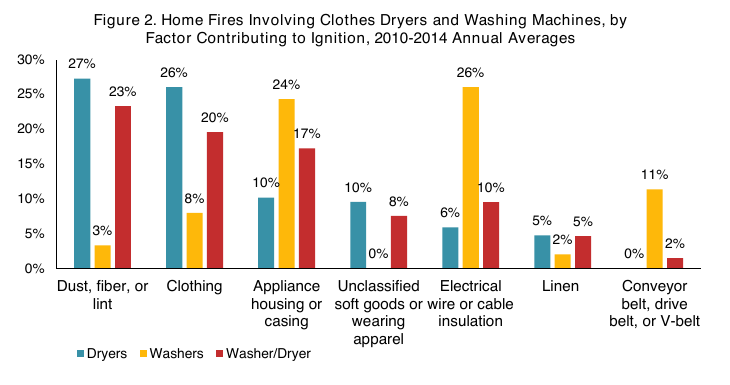
- In 2010 to 2014, lint was the first item ignited in 27 percent of dryer fires (NFPA, Mar 2017).
- In combination washer-dryers, lint was the first item ignited in 23 percent of fires (NFPA, Mar 2017).
- In residential buildings in 2008 to 2010, lint accounted for 27.6 percent of items first ignited (USFA, Aug 2012).
What else burns?
- Clothing was the first item ignited in 3,440 dryer fires a year, or 25 percent (NFPA, Jun 2020).
- Clothing ignitions caused 30 percent of dryer fire injuries (NFPA, Jun 2020).
- Appliance housing or casing was first ignited in 12 percent of dryer fires (NFPA, Jun 2020).
- Unclassified soft goods or wearing apparel ignited first in 11 percent (NFPA, Jun 2020).
- Electrical wire or cable insulation ignited first in 6 percent (NFPA, Jun 2020).
- Linen other than bedding ignited first in 5 percent, and mattress or bedding in 3 percent (NFPA, Jun 2020).
- Clothing not on a person accounted for 27.2 percent of first ignitions in residential buildings in 2008 to 2010 (USFA, Aug 2012).
- Other soft goods, wearing apparel or clothing accounted for 8.8 percent (USFA, Aug 2012).
- A full load of wet clothes can hold as much as one and a half gallons of water, which the dryer must move out through the vent along with the lint (USFA, Aug 2012).
Are gas or electric dryers more likely to catch fire?
Electric dryers show up more in fire counts because there are far more of them. The housing surveys show the same split, so the fire share roughly tracks use.
How do fire counts split by fuel?
- Electric dryers were involved in 10,740 home fires a year in 2014 to 2018, or 78 percent (NFPA, Jun 2020).
- Electric dryer fires caused $191 million in damage a year, 82 percent of the total (NFPA, Jun 2020).
- Electric dryer fires caused 264 injuries a year, or 77 percent (NFPA, Jun 2020).
- Gas dryers were involved in 3,060 home fires a year, or 22 percent (NFPA, Jun 2020).
- Gas dryer fires caused 80 injuries a year and $42 million in damage (NFPA, Jun 2020).
- CPSC estimated 3,800 electric dryer fires a year from 2020 to 2022 (CPSC, Apr 2026).
- CPSC estimated 900 gas dryer fires a year in the same period (CPSC, Apr 2026).
- CPSC put electric dryer fire losses at $46.8 million a year and gas dryer losses at $12.4 million (CPSC, Apr 2026).
How common is each fuel?
- In the American Housing Survey, 79 percent of household dryers in 2017 ran on electricity and 21 percent on gas (NFPA, Jun 2020).
- Households using electric dryers outnumbered those using gas dryers by 3.9 to 1 in the 2013 and 2015 surveys (NFPA, Mar 2017).
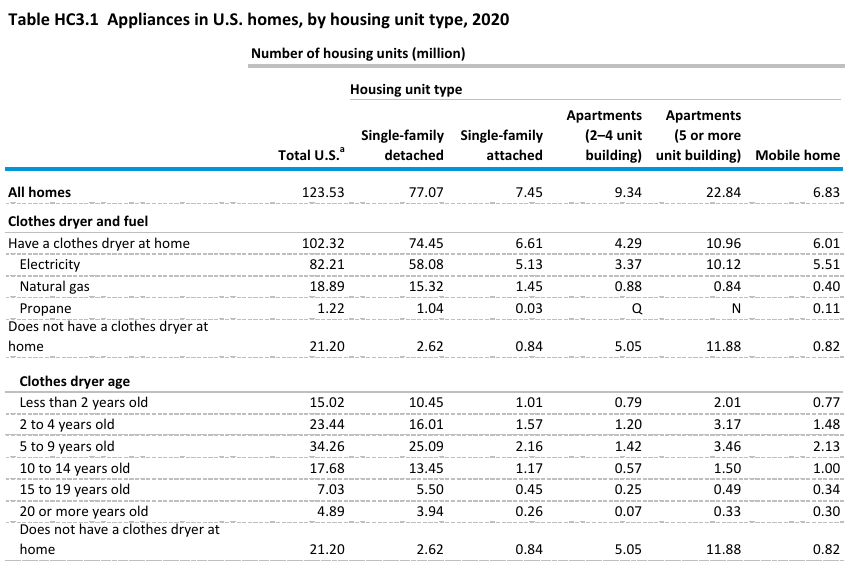
- Of the roughly 102 million homes with a dryer, 82.21 million used electricity, 18.89 million used natural gas and 1.22 million used propane (EIA, Mar 2023).
- Another 21.20 million homes had no clothes dryer (EIA, Mar 2023).
- Apartments in buildings with five or more units had 10.96 million dryers among 22.84 million homes (EIA, Mar 2023).
How old are the dryers in use?
- About 15.02 million homes had a dryer less than 2 years old (EIA, Mar 2023).
- About 34.26 million homes had a dryer 5 to 9 years old, the largest age group (EIA, Mar 2023).
- About 17.68 million homes had a dryer 10 to 14 years old (EIA, Mar 2023).
- About 7.03 million homes had a dryer 15 to 19 years old (EIA, Mar 2023).
- About 67.48 million homes ran the dryer 1 to 4 loads a week, and 25.93 million ran it 5 to 9 loads (EIA, Mar 2023).
Where and when do clothes dryer fires start?
These fires follow the laundry schedule. They start in laundry areas, in houses, in the afternoon and in the cold months.
Which rooms and homes?
- One- and two-family homes accounted for 77.1 percent of clothes dryer fires in residential buildings (USFA, Aug 2012).
- Multifamily dwellings accounted for 17.4 percent (USFA, Aug 2012).
- Hotels and motels accounted for 3.0 percent (USFA, Aug 2012).
- The laundry area was the area of origin in 82.6 percent of fires (USFA, Aug 2012).
- Substructure areas such as crawl spaces were the origin in 2.6 percent, and garages or carports in 2.5 percent (USFA, Aug 2012).
- The laundry room or area was the area of origin in 82 percent of dryer fires, 77 percent of washer fires and 83 percent of combination fires (NFPA, Mar 2017).
Which months and hours?
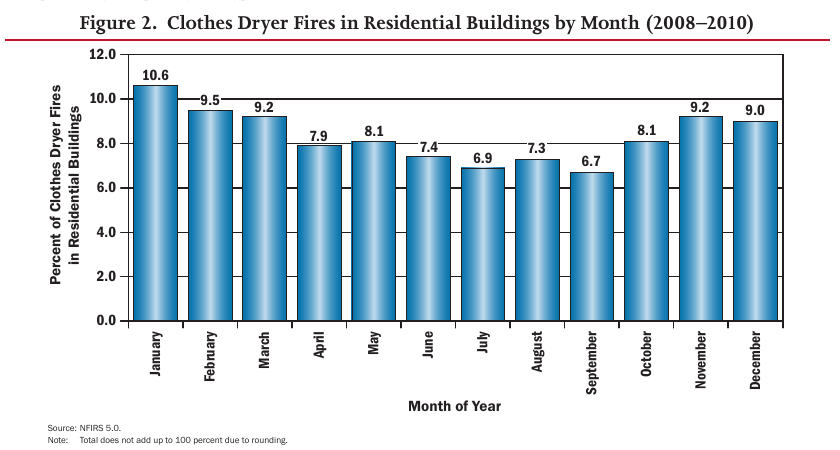
- Fires peaked in January at 10.6 percent of the yearly total (USFA, Aug 2012).
- February accounted for 9.5 percent and November for 9.2 percent (USFA, Aug 2012).
- September was the low month at 6.7 percent (USFA, Aug 2012).
- The peak hour was 1 to 2 p.m., at 6.7 percent of fires (USFA, Aug 2012).
- The lowest hour was 5 to 6 a.m., at 0.9 percent of fires (USFA, Aug 2012).
How far do dryer fires spread, and do smoke alarms help?
Cost climbs fast once a dryer fire leaves the machine. The fires that spread decide the bill.
How far do they spread?
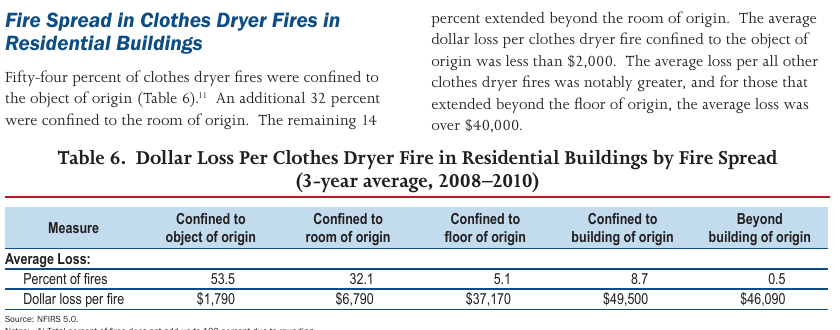
- 53.5 percent of fires were confined to the object of origin, with an average loss of $1,790 (USFA, Aug 2012).
- 32.1 percent were confined to the room of origin, at $6,790 per fire (USFA, Aug 2012).
- 5.1 percent were confined to the floor of origin, at $37,170 per fire (USFA, Aug 2012).
- 8.7 percent were confined to the building of origin, at $49,500 per fire (USFA, Aug 2012).
- 0.5 percent spread beyond the building of origin, at $46,090 per fire (USFA, Aug 2012).
Were alarms and sprinklers there?
- Smoke alarms were present in 62.3 percent of clothes dryer fires in residential buildings (USFA, Aug 2012).
- Firefighters could not determine whether an alarm was present in 20.2 percent of fires (USFA, Aug 2012).
- In occupied residential buildings, smoke alarms were present in 64 percent of dryer fires (USFA, Aug 2012).
- When alarms were present, they operated in 66 percent of the fires and failed to operate in 12 percent (USFA, Aug 2012).
- Automatic extinguishing systems were present in 5.0 percent of dryer fires (USFA, Aug 2012).
How do washing machine fires compare with dryer fires?
Washers burn far less often than dryers, and for different reasons. A washer fire starts in the machine. A dryer fire starts in what the machine is drying.
How big is the washer share?
- Washer-dryer combinations accounted for 5 percent of the fires, or 720 a year (NFPA, Mar 2017).
- Washing machines accounted for 620 fires a year and 4 of the 13 civilian deaths (NFPA, Mar 2017).
- CPSC estimated 300 washing machine fires a year from 2020 to 2022 (CPSC, Apr 2026).
- CPSC estimated 400 washing machine fires a year from 2018 to 2020 (CPSC, Aug 2023).
- CPSC put washing machine fire losses at $4.8 million a year from 2020 to 2022 (CPSC, Apr 2026).
What starts a washer fire?
- Mechanical failure or malfunction was a factor in 44 percent of washing machine fires (NFPA, Mar 2017).
- Electrical failure or malfunction was a factor in 42 percent (NFPA, Mar 2017).
- Electrical failures accounted for 60 percent of direct property damage in washer fires (NFPA, Mar 2017).
- Electrical wire or cable insulation was the first item ignited in 26 percent of washer fires (NFPA, Mar 2017).
- Appliance housing or casing ignited first in 24 percent, and drive belts in 11 percent (NFPA, Mar 2017).
- In combination washer-dryers, mechanical failure was a factor in 34 percent of fires (NFPA, Mar 2017).
Dryer vent fire statistics: what do the vent and circuit rules say?
The rules are specific, and several of them go to lint and heat. The numbers below are quoted from the 2024 International Residential Code, a model code that a state or city may or may not adopt. Check the code year in force where you work and ask the local authority.
What do the exhaust duct rules require?
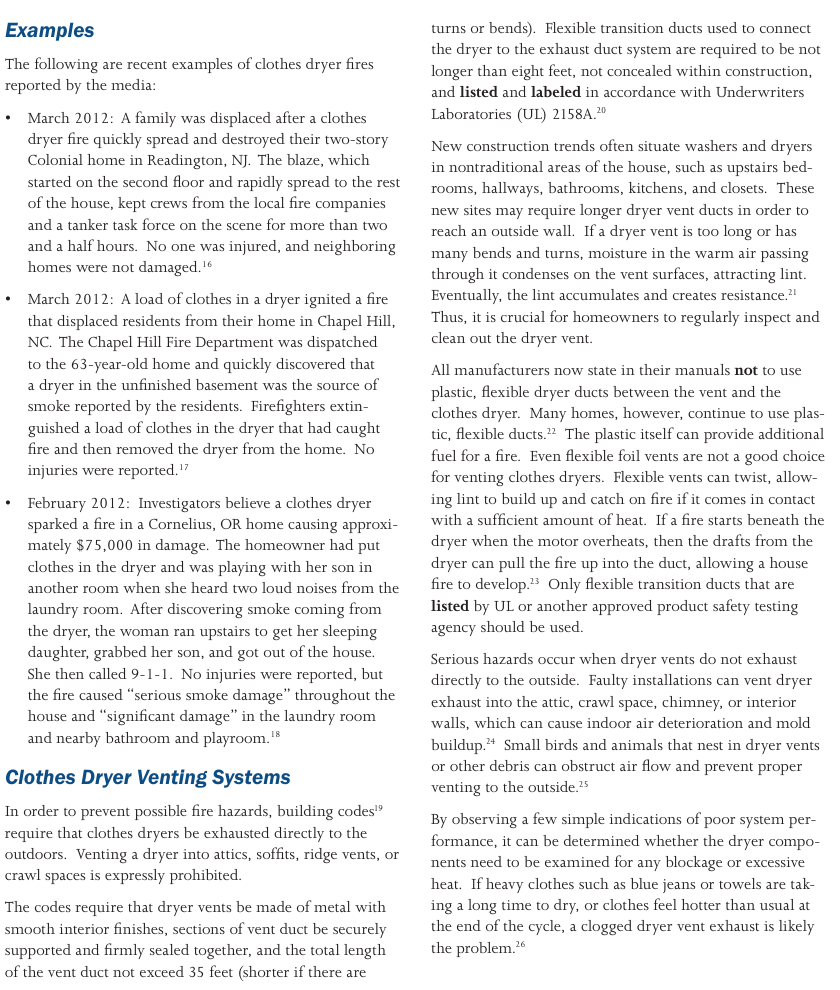
- Exhaust ducts must be metal with a smooth interior, at least 0.0157 inch thick, and 4 inches in nominal diameter (ICC, Jan 2024).
- Ducts must be supported at intervals of no more than 12 feet (ICC, Jan 2024).
- The transition duct between the dryer and the exhaust duct may be no longer than 8 feet and may not be concealed in construction (ICC, Jan 2024).
- Domestic booster fans are not allowed in dryer exhaust systems (ICC, Jan 2024).
- The exhaust duct must end outdoors at least 3 feet from building openings, unless the dryer maker says otherwise, and screens are not allowed at the end (ICC, Jan 2024).
- The duct end must keep an open area of at least 12.5 square inches (ICC, Jan 2024).
- Where the equivalent length goes past 35 feet, a permanent label must state it within 6 feet of the duct connection (ICC, Jan 2024).
- Where nails or screws could reach the duct, steel shield plates at least 0.062 inch thick must protect it (ICC, Jan 2024).
- Dryer installations that exhaust more than 200 cubic feet per minute need makeup air (ICC, Jan 2024).
- USFA notes that moisture condensing in a long or bent vent attracts lint, which builds up until it restricts airflow (USFA, Aug 2012).
What do the circuit rules require?
Sizing the dryer branch circuit is a code lookup, and the load rule is simple: use the larger of 5,000 volt-amperes or the nameplate. The free 30 amp wire size and residential load calculators run these checks for you, and the result is an aid that does not replace the adopted code or the local authority.
- The dryer load in a feeder calculation is 5,000 VA for each dryer circuit or the nameplate rating, whichever is greater (ICC, Jan 2024).
- A dwelling must have at least one 20-ampere laundry branch circuit serving only laundry area receptacles (ICC, Jan 2024).
- For feeders that supply electric dryers, the maximum unbalanced load is taken as 70 percent of the load on the ungrounded conductors (ICC, Jan 2024).
- In the service load table, a dryer not on the laundry branch circuit is added at its nameplate volt-ampere rating (ICC, Jan 2024).
- Ground-fault circuit-interrupter protection applies to dryers on circuits rated 150 volts or less to ground and 60 amperes or less (ICC, Jan 2024).
Which product standards changed?
- NFPA lists a high-limit temperature control requirement for dryers, with an effective date of March 2019 (NFPA, Mar 2017).
- NFPA lists a drum drive requirement that de-energizes the heater if the drum stops, with an effective date of March 2019 (NFPA, Mar 2017).
- NFPA lists a mandatory cool-down requirement, with an effective date of March 2019 (NFPA, Mar 2017).
- NFPA lists a flame-resistant plastics requirement near electrical connections, with an effective date of March 2019 (NFPA, Mar 2017).
Which clothes dryers has CPSC recalled for fire risk?
A recall is not a fire rate, but it shows where design flaws turned up. Several of these recalls name lint buildup or overheating as the hazard.
Which recalls are recent?
- Electrolux reported one smoke inhalation injury along with the fire reports on the Frigidaire gas laundry centers (CPSC, Jul 2023).
- Whirlpool recalled about 2,500 stacked commercial ADC dryers sold for multi-unit housing, laundromats and similar sites (CPSC, Sep 2023).
- Whirlpool had received 41 reports of incidents on the ADC dryers (CPSC, Sep 2023).
Which older recalls are on record?
- LG and Sears recalled about 21,000 gas dryers in 2012 after 141 complaints that they kept heating after the cycle ended (CPSC, Aug 2012).
- The same recall noted three reports of minor burns (CPSC, Aug 2012).
- Maytag inspected and repaired up to 73,000 older gas dryers in 1997 (CPSC, Jan 1997).
- Maytag had received over 30 reports of dryer fires possibly caused by an electrical switch malfunction (CPSC, Jan 1997).
- Whirlpool recalled about 17,000 combination washer and gas dryer units in 2002 after two reports of overheating (CPSC, Jul 2002).
- Miele recalled gas dryers in 2008 after 11 reports of gas smell and one report of a fire causing property damage (CPSC, May 2008).
- Frigidaire recalled about 35,000 clothes washers in 2009 for a drain pump defect that could cause a fire (CPSC, Jul 2009).
- GE Appliances recalled about 222,000 top-loading washers in 2016 after 71 reports of components burning or catching fire (CPSC, Sep 2016).
Methodology and Sources
Every figure comes from the agency that produced it: NFPA, USFA, CPSC, EIA or the International Code Council. No roundup pages are cited. Each source link was opened, and each number was read from the saved report, table or notice. Fire estimates cover fires reported to U.S. fire departments, and the agencies define “dryer fire” differently, so compare trends inside one source rather than across them. The NFPA dryer report used here covers 2014 to 2018 and the USFA dryer report covers 2008 to 2010. The CPSC estimates are the newest, through 2022. The page is refreshed monthly. For the wider picture, see the related pages on house fire causes and electrical fires.
Glossary
- NFIRS: the National Fire Incident Reporting System, the USFA database that fire departments report into.
- NFPA, USFA, CPSC, EIA: National Fire Protection Association, U.S. Fire Administration, Consumer Product Safety Commission, Energy Information Administration.
- IRC: International Residential Code, a model code published by the International Code Council.
- GFCI: ground-fault circuit interrupter.
- VA: volt-amperes.
- Confined fire: a fire limited to the object of origin.
Sources
- NFPA, Home Dryer Fires, Jun 2020
- NFPA, Home Fires Involving Clothes Dryers and Washing Machines, Mar 2017
- USFA, Clothes Dryer Fires in Residential Buildings (2008 to 2010), Aug 2012
- USFA, Appliances and Electrical fire prevention, May 2023
- CPSC, 2020 to 2022 Residential Fire Loss Estimates, Apr 2026
- CPSC, 2019 to 2021 Residential Fire Loss Estimates, Jul 2024
- CPSC, 2018 to 2020 Residential Fire Loss Estimates, Aug 2023
- CPSC recall notices: Frigidaire gas laundry centers (Jul 2023), ADC stacked commercial dryers (Sep 2023), LG and Sears gas dryers (Aug 2012), Maytag gas dryers (Jan 1997), Whirlpool washer and gas dryer units (Jul 2002), Miele gas dryers (May 2008), Frigidaire washers (Jul 2009), GE top-loading washers (Sep 2016)
- EIA, Residential Energy Consumption Survey 2020, Table HC3.1, Mar 2023
- ICC, 2024 International Residential Code, Chapter 15 Exhaust Systems, Jan 2024
- ICC, 2024 International Residential Code, Chapter 36 Services, Jan 2024
- ICC, 2024 International Residential Code, Chapter 37 Branch Circuit and Feeder Requirements, Jan 2024
- ICC, 2024 International Residential Code, Chapter 39 Power and Lighting Distribution, Jan 2024
Cite this page
Every figure links to the source that published it. Quote one with a link to this page or to the source.
WireGaugeCalc. "154 Dryer Fire Statistics October 2026." WireGaugeCalc, October 2026. https://www.wiregaugecalc.com/statistics/dryer-fire-statistics/ <a href="https://www.wiregaugecalc.com/statistics/dryer-fire-statistics/">Dryer Fire Statistics</a> (WireGaugeCalc, October 2026)